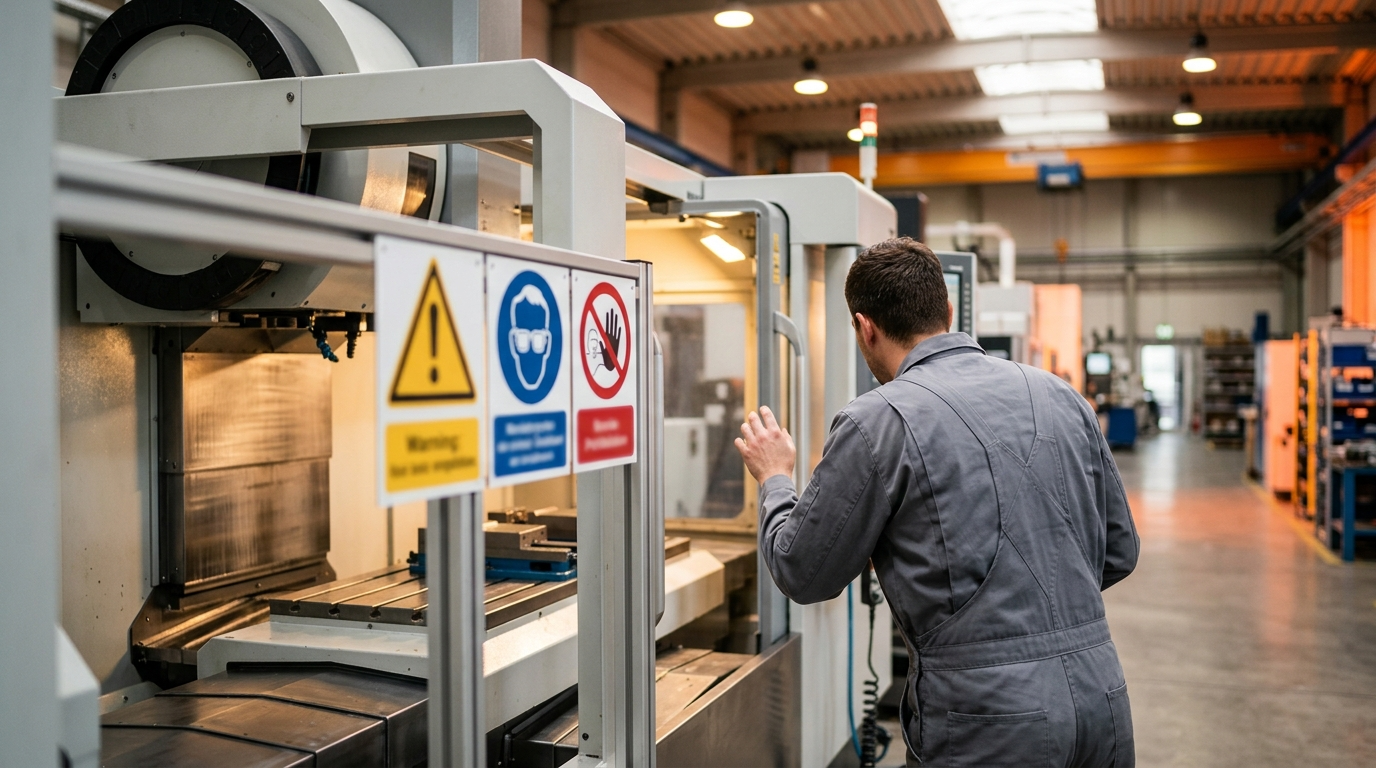
Why there is no universal sticker checklist
"Which stickers do I need to put on my machine?" - We have been receiving this question at least twice a week for over 20 years. The answer frustrates many when they first hear it: There is no blanket list
.No standard in the world stipulates that stickers A, B and C belong on a CNC milling machine. And stickers D, E and F on a hydraulic press. The reason is simple: each machine has an individual risk profile. A lathe with an open clamping device needs different warning signs than an identical-looking lathe with a complete protective cover. The hazards differ - and so does the labeling.
Instead, there is a clearly defined process that derives the necessary labeling for each individual machine. This process is called risk assessment.Risk assessment in accordance with DIN EN ISO 12100 - the only reliable way
DIN EN ISO 12100 ("Safety of machinery - General principles for design") describes a three-stage process for risk reduction. The safety marking is deliberately placed at the end of the chain - not at the beginning:
The risk assessment therefore first identifies all hazards (mechanical, electrical, thermal, noise, radiation, substances, etc.), evaluates their severity and probability of occurrence and defines measures to reduce the risk. Only what remains as a residual risk must be communicated by means of safety signs on the machine and in the operating instructions.
What safety signs are there? ISO 7010 and ANSI Z535 at a glanceOnce the risk assessment has determined which residual risks need to be communicated, the question arises as to how. Two systems have become established internationally:
DIN EN ISO 7010 - the European standard
DIN EN ISO 7010 defines uniform safety signs that are recognized throughout Europe (and largely internationally). It works with three categories:
| Category | Shape & color | Meaning | Example |
|---|---|---|---|
| Prohibition sign | Round, red border with horizontal bar | Action is prohibited | P010 - Touching prohibited |
| Warning sign | Triangular, yellow with black border | Danger or risk | W012 - Warning of electrical voltage |
| Mandatory sign | Round, blue | Action is required | M004 - Use eye protection |
ANSI Z535 - mandatory for US export
Whoever exports machines to the USA or Canada must comply with the ANSI Z535 series (in particular ANSI Z535.4 for product safety labels). The ANSI system works with color-coded signal words that communicate the severity of the hazard:
| Signal word | Meaning | When to use |
|---|---|---|
| DANGER | Immediate danger that causes death or serious injury | Highest level - only in case of immediate, acute danger to life |
| WARNING | Danger that can cause death or serious injury | Most common level in mechanical engineering |
| CAUTION | Danger that can cause minor to moderate injury | Lower injury severity, e.g. bruising |
| NOTICE | Property damage or operational information (no danger to persons) | Note on machine damage, operating conditions |
| SAFETY INSTRUCTIONS | General safety instructions | Overarching safety rules, e.g. at the machine entrance |
And what about the new EU Machinery Regulation?
The EU Machinery Regulation (EU) 2023/1230 will replace the previous Machinery Directive 2006/42/EC from January 20, 2027. The principle of the basic requirements for safety marking will not change: marking will continue to be based on the risk assessment. However, the requirements for documentation will become stricter - among other things, the risk assessment will in future be a mandatory part of the technical documentation that must be submitted to market surveillance on request.
▶ Configure safety labeling in accordance with ISO 7010 and ANSI Z535In 6 steps to correct machine marking
- Carry out a risk assessment Identify all hazards on your machine in accordance with DIN EN ISO 12100, taking into account the intended use and the reasonably foreseeable misuse.
- Risk reduction in the right order Check for each hazard: Can it be eliminated by design? If not: Is a technical protective device possible? Only when both have been exhausted comes step 3 - the user information .
- Document residual risks Record in writing which residual risks remain and where they occur on the machine. This list is your basis for labeling. Determine target market Europe? Then ISO 7010. USA/Canada? Then ANSI Z535.4. Both markets? Then you need both systems - ideally as combined signs or with separate sign sets for each market.Select and position safety signs Choose the right sign for each residual risk. Place it in the line of sight to the danger point - not at the rear of the machine if the danger is at the front. Observe the minimum sizes according to ISO 3864-1 (detection distance).Determine material and durability Machines in outdoor areas or wet rooms need UV and chemical-resistant films. For standard applications in the production hall, high-quality industrial films with a durability of at least 7 years are suitable.
5 errors that we have seen again and again for 20 years
Why machine manufacturers rely on ergo-safe
Compliant ex works
All safety signs comply with DIN EN ISO 7010, ISO 3864 and ANSI Z535.4. You receive labeling that passes the audit - without having to do your own standards research.
Online configurator
In the ergo-safe store, you can configure your own signs: Signal word, pictogram, text language, format and material - in just a few clicks, with live preview.
Multilingual for export
Whether German, English, French, Chinese or Arabic - ergo-safe delivers your safety labeling in the language of your target market.
Industrial quality
Printed on high-quality industrial film, UV-resistant, chemical-resistant and designed for continuous use in harsh production environments.
Design service included
Do you have a risk assessment but no signs? Our team will translate your requirements into standard-compliant layouts - as a complete set of signs for the entire machine if required.
Experience since 2001
Over 20 years of experience in safety labeling for mechanical engineering. We know the standards, the materials and the typical pitfalls
.Frequently asked questions
Is there a standard that specifies which stickers belong on which machine?
No. No standard provides a machine-specific sticker list. DIN EN ISO 12100 describes the risk assessment process from which the necessary labeling results individually. Type C standards (e.g. for lathes, presses) may contain more specific information, but do not replace your own risk assessment.
How much does a set of safety stickers for a machine cost?
This depends on the number, size, material and languages. A typical set of signs for a medium-sized machine tool with 10-20 safety signs starts at a few euros per set in series production. In the ergo-safe store, you can configure individual signs or complete sets and receive an immediate price overview.
Do I need ISO 7010 or ANSI Z535 - or both?This depends on the target market. ISO 7010 is the standard for the European market. For the USA and Canada, ANSI Z535.4 applies. If you export to both regions, you generally need both systems. Combination signs that combine the ISO pictogram and ANSI text field are a space-saving solution.
In which languages does ergo-safe supply safety signs?In principle, in every language of your target market. German, English, French, Spanish, Italian, Portuguese, Chinese and Arabic are available as standard. We can implement other languages on request.
What happens if I don't have a risk assessment and stick stickers anyway?
The stickers are then not comprehensibly justified. In the event of damage, an expert may determine that the labeling was incomplete - for example because a hazard was overlooked. Without a documented risk assessment, you as the manufacturer bear the full burden of proof that your labeling was sufficient.
How large must safety signs on machinery be?ISO 3864-1 defines the minimum size depending on the detection distance. Rule of thumb: The diameter of a safety sign should be at least 1/200 of the maximum detection width. At a distance of 4 m, this results in a diameter of at least 20 mm - in practice, we recommend at least 50 mm for machines.
Does ergo-safe also offer support with risk assessment?
Our core business is safety labeling. For the risk assessment itself, we recommend working with a specialist safety engineer or CE consultant. As soon as the results are available, we take over the standard-compliant implementation in sign form - including layout creation and positioning proposal on request.
Safety signage that passes the audit
Configure standard-compliant safety signs in accordance with ISO 7010 and ANSI Z535 directly in the ergo-safe store - or let our team create a complete set of signs for your machine
.▶ To the safety signs in the shop
Questions about machine labeling?